
UEHR Researcher Panagiotis Koronaios organises a workshop on rural youth and the bioeconomy at the Global Bioeconomy Summit 2026 in Dublin
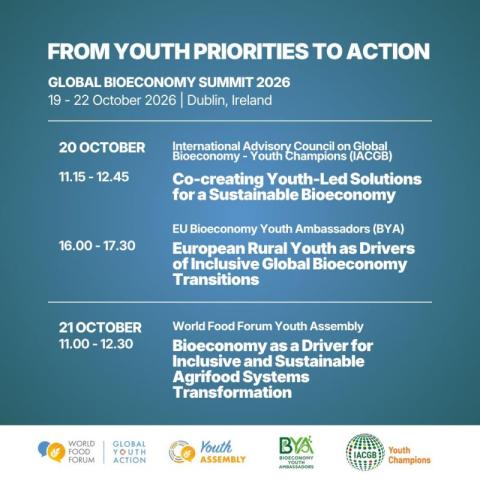
Panagiotis Koronaios, Researcher at the Institute of Urban Environment and Human Resources (UEHR), PhD candidate at Panteion University and EU Bioeconomy Youth Ambassador, is the workshop leader of “From Youth Priorities to Action 2: European Rural Youth as Drivers of Inclusive Global Bioeconomy Transitions”. The workshop will take place at the Global Bioeconomy Summit 2026 (GBS2026) in Dublin on Tuesday 20 October 2026, 16:00–17:30.
The proposal was selected from 118 submissions. The workshop is the second in a series of three, organised by the EU Bioeconomy Youth Ambassadors together with the IACGB Youth Champions and the World Food Forum (FAO) Youth Assembly. It is supported by the HORIZON research project BIO2REG (“Enabling Regions to Transition towards Bioeconomy”), in which UEHR is a partner.
The workshop’s central question is how rural young people can become drivers of the bioeconomy transition, not only its beneficiaries. The discussion is structured in three steps:
- Success cases. Three European regions with strong performance in bioeconomy sectors are presented: Sjælland in Denmark (bio-based chemicals), Champagne-Ardenne in France (agriculture) and the Southern Region of Ireland (food processing).
- Multi-criteria assessment. Based on a TOPSIS analysis of 241 NUTS 2 regions, each success case is paired with a structurally comparable high-potential region: Mecklenburg-Vorpommern (Germany), Střední Čechy (Czechia) and Auvergne (France).
- World Café. Participants discuss in groups which factors explain success and which conditions can actually be transferred. These include governance, producer organisation, access to finance, innovation ecosystems and education. They also examine which barriers are structural and which are circumstantial.
The results will be synthesised into youth-driven policy recommendations. These will feed into the overall youth contribution of the workshop series to GBS2026.